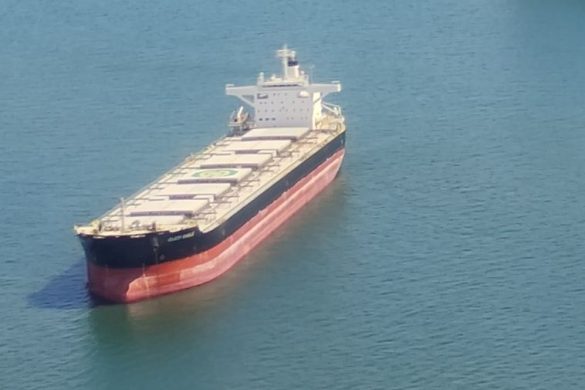

Global trade disruption. Image by Green Oak at Shutterstock
The continuing closure of the Strait of Hormuz feels increasingly like the phony war, the period in World War II between the German invasion of Poland and the attack on France in May the following year.
The world’s economy is remarkably calm yet there is a growing sense that something very bad is just over the horizon.
In the case of crude oil this is easy to understand. Goldman Sachs in late April estimated a daily crude oil inventory draw of 11-12M barrels. Once inventories approach the minimum level that can sustain this draw rate, oil prices will rise rapidly to a level that will clear the market and make a global recession inevitable.
Given the 3-4 week lead time between vessels departing the Gulf and stocks refilling, plus any additional delays due to restarting production and export, we are quickly approaching an economic catastrophe.
Bear in mind, it is not the global inventory pool that matters. As soon as any large importer of crude exhausts its inventory, prices will rise rapidly because in the short term, oil demand is highly price inelastic.
There are other well-known economic shocks on the horizon. The Gulf is a major source of urea fertiliser and the loss of shipments threatens food shortages and hunger, with the developing world at serious risk of food insecurity or worse because of the war. Sulphur shipments, which are important to phosphate fertilisers as well as metal extraction and refining, are also blocked.
This note looks a little more closely at helium, another industrial input for which the Gulf is perhaps the largest merchant source. Compared to a global recession or serious food shortages, economic disruption from helium supply curtailments is not much more than an inconvenience, but in the context of minor metals it is something worth paying attention to.
Qatar’s Ras Laffan LNG export terminal is the world’s largest single producer of helium (recovered alongside LNG) and also reportedly incorporates purification units able to purify helium to 6N purity.
On top of this the Qatari exporter holds a large inventory of specialised cryogenic vessels able to preserve helium in liquid form for marine transportation. The Iranian attack that knocked Ras Laffan offline has also, at a stroke, shut down its helium export facilities and, thanks to the blockade of the Strait of Hormuz, has halted the circulation of cryogenic containers, meaning the entire helium distribution system is disrupted. Even if the conflict ended today, it would be months before the helium supply was back to normal.
Helium is a critical input into several industries that are reliant also on critical metals, thus a prolonged disruption in helium supply will have knock-on effects in the minor metal world. Most exposed are metals essential to semiconductor fabrication, notably hafnium, titanium, tungsten, zirconium, tantalum, and increasingly cobalt, ruthenium and molybdenum.
Helium’s main use in semiconductor manufacturing is to conduct heat from the back side of silicon wafers during high temperature processing, particularly wafer etching. Etching is an energy intensive process and helium’s ability to penetrate throughout the backside of in-process wafers and to conduct heat quickly away are vital to production yield. While the majority of this helium is recycled, there are some inevitable losses during post-use re-pressurisation and
re-purification, so a constant make-up supply of fresh helium is required.
Deposition processes also use helium (atomic layer deposition, for example) and while it may be possible to switch to other inert gases, such a shift will alter the thermodynamics of the deposition process, requiring potentially lengthy development and requalification.
The continuing closure of the Strait of Hormuz feels increasingly like the phony war, the period in World War II between the German invasion of Poland and the attack on France in May the following year.
The world’s economy is remarkably calm yet there is a growing sense that something very bad is just over the horizon.
In the case of crude oil this is easy to understand. Goldman Sachs in late April estimated a daily crude oil inventory draw of 11-12M barrels. Once inventories approach the minimum level that can sustain this draw rate, oil prices will rise rapidly to a level that will clear the market and make a global recession inevitable.
Given the 3-4 week lead time between vessels departing the Gulf and stocks refilling, plus any additional delays due to restarting production and export, we are quickly approaching an economic catastrophe.
Bear in mind, it is not the global inventory pool that matters. As soon as any large importer of crude exhausts its inventory, prices will rise rapidly because in the short term, oil demand is highly price inelastic.
There are other well-known economic shocks on the horizon. The Gulf is a major source of urea fertiliser and the loss of shipments threatens food shortages and hunger, with the developing world at serious risk of food insecurity or worse because of the war. Sulphur shipments, which are important to phosphate fertilisers as well as metal extraction and refining, are also blocked.
This note looks a little more closely at helium, another industrial input for which the Gulf is perhaps the largest merchant source. Compared to a global recession or serious food shortages, economic disruption from helium supply curtailments is not much more than an inconvenience, but in the context of minor metals it is something worth paying attention to.
Qatar’s Ras Laffan LNG export terminal is the world’s largest single producer of helium (recovered alongside LNG) and also reportedly incorporates purification units able to purify helium to 6N purity.
On top of this the Qatari exporter holds a large inventory of specialised cryogenic vessels able to preserve helium in liquid form for marine transportation. The Iranian attack that knocked Ras Laffan offline has also, at a stroke, shut down its helium export facilities and, thanks to the blockade of the Strait of Hormuz, has halted the circulation of cryogenic containers, meaning the entire helium distribution system is disrupted. Even if the conflict ended today, it would be months before the helium supply was back to normal.
Helium is a critical input into several industries that are reliant also on critical metals, thus a prolonged disruption in helium supply will have knock-on effects in the minor metal world. Most exposed are metals essential to semiconductor fabrication, notably hafnium, titanium, tungsten, zirconium, tantalum, and increasingly cobalt, ruthenium and molybdenum.
Helium’s main use in semiconductor manufacturing is to conduct heat from the back side of silicon wafers during high temperature processing, particularly wafer etching. Etching is an energy intensive process and helium’s ability to penetrate throughout the backside of in-process wafers and to conduct heat quickly away are vital to production yield. While the majority of this helium is recycled, there are some inevitable losses during post-use re-pressurisation and
re-purification, so a constant make-up supply of fresh helium is required.
Deposition processes also use helium (atomic layer deposition, for example) and while it may be possible to switch to other inert gases, such a shift will alter the thermodynamics of the deposition process, requiring potentially lengthy development and requalification.
For now the major semiconductor manufacturers have stated that they hold sufficient inventories of helium to last several months. Strains on production are probably due to the demand from AI, which is saturating leading-edge fabrication capacity, with more mature fabs operating at much lower utilisations. If helium supply tightens significantly, look to manufacturers to protect their high margin business while reducing production at larger nodes.
Such a shift would further imperil lower margin consumer devices and potentially also the automotive sector, a potential reprise of sorts of the Covid disruptions that shuttered production lines due to shortages of automotive chips.
Medical imaging is another important user of helium, in MRI machines built around superconducting niobium-titanium wires. Most MRI machines operate thanks to about 2,000 litres of liquid helium (some new designs operate with little to no helium but while these so-called “dry” systems are growing in share of new sales, the installed base of MRI machines is overwhelmingly reliant on large volumes of helium).
Helium has two main functions in the MRI machine. The first is to hold the niobium-titanium wires at a low enough temperature that they behave as superconductors (just a few degrees kelvin), a feat that is accomplished in part by the slow boil-off of helium. Estimates suggest 40-50% of the helium in the magnet will boil off over the course of a year, requiring substantial volumes for refilling periodically.
The second function is to absorb the huge heat generated if the magnet switches from superconducting to normal conducting (termed “quenching”) by boiling off in toto to carry away the enormous energy release.
We do not expect an immediate impact on the operating MRI fleet, other than perhaps less intense use of the existing base. But a prolonged crisis is likely to shift demand much more heavily towards dry machines, meaning (because of capacity constraints) that many purchases could be deferred and existing systems operated longer.
The niobium-titanium wire market is not huge, perhaps in the range of 2,000-3,000tpy, but it is a high value market and an important application for specialty niobium (“triple R” grade).
Helium is also important in fibreoptic manufacturing, where it is used to cool rapidly the just-drawn fibres pulled from a melt. Here, helium’s high thermal conductivity allows the rate of fibre-pulling to increase, and conversely, without helium (nitrogen and argon are possible substitutes) the rate of fibre drawing will reduce.
In the minor metals world, the largest impact will be felt by germanium demand, with germanium commonly added as a dopant in fibreoptic cores to adjust the refractive index profile of the fibre.
Finally, there are multiple uses of helium in space, aerospace and general industrial manufacturing. Leak testing is a substantial use of helium and while other gases can often be substituted, there are instances where the certainty required by the process for gas tightness demands helium leak testing.
And in most operating commercial rockets, helium is used to maintain pressure in the fuel tanks as fuel is consumed. Here it is indispensable thanks to its low density and exceptionally low freezing point. Helium is also required for purging and leak-testing of fuel supply systems in rocketry.
A prolonged shortage of helium will have an impact on superalloy demand. Often substitutes (nitrogen, argon, hydrogen in rare occasions though its explosion risk severely limits use) are available, but in the most demanding applications helium is irreplaceable. Substitutes, when feasible, present compromises. Without enough helium for a prolonged period, fewer aerospace systems will be built, fewer rockets will fly.
Before the conflict started, demand for minor metals across all these markets was robust. That narrative has not yet collapsed, but unless the Strait is re-opened in the next few months, our industry as a whole faces escalating and negative ramifications, not just from the macroeconomic damage of exponentiating oil prices, but from the curtailment of production thanks to the loss of helium, a surprisingly critical material.
Footnote:
The conflict is likely to lead to gains for minor metals especially in renewable energy and electrification applications, although on a multi-year timeline. We will return to this in a subsequent piece.
By Andrew Mattheson and Patrick Stratton
OnG Commodities
 OnG Commodities LLC is an independent, privately held US company established in 2014. It provides research and consulting services pertaining to minor metals (Ta, Nb, Sc, Cs, Hf).
Besides sole practitioner work, OnG has also worked with, and distributed research through, Roskill and CPM Group.