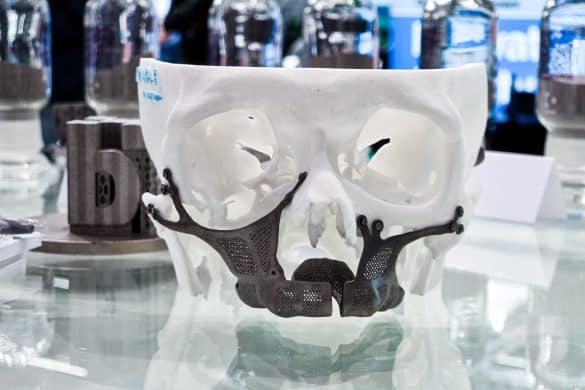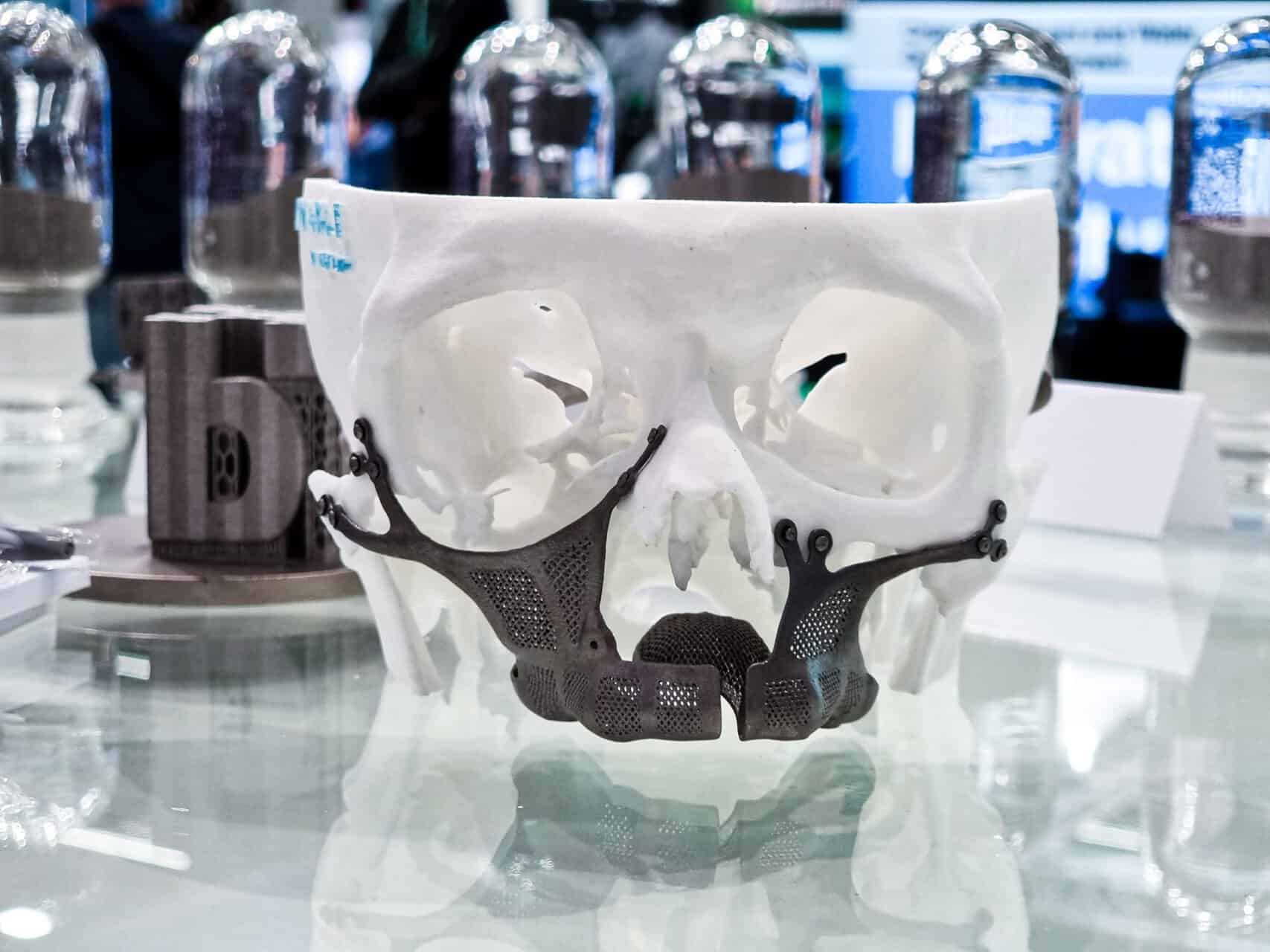
In this guest article TANIOBIS, a leading processor of tantalum and niobium based materials guides us through a range of biocompatible materials and how they are used in medical engineering.
The demands placed on modern implants are extremely high. Customized design, good compatibility, durability, as well as low risk of infection are becoming increasingly important. The use of alloy powders based on tantalum and niobium in modern 3D printing processes is presenting a host of new possibilities. here. Huge progress is currently being made particularly in developing patient-specific implants of complex structures that very closely resemble the properties of natural bones.
Medical implants are now an inherent part of many therapeutic surgical procedures and make an important contribution to maintaining and restoring patients’ mobility, functionality and quality of life. They range from filigree, barely visible components to larger structures that often remain in a person’s body on a permanent basis. To ensure that these kinds of implants function reliably, the host body, must tolerate them without any restrictions. If this compatibility is not available, the person’s body may react with inflammation or, in the worst possible scenario, completely reject the component. Biocompatible materials and modern production processes, particularly 3D printing, make it possible to manufacture implants meeting these requirements and the specific patients’ needs.
Ti-6Al-4V: The traditional standard with biological restrictions
More than 90 percent of all dental and orthopaedic implants are made from Ti-6-4 alloy. Image: TANIOBIS
Ti-6AI-4V, an alloy made of titanium (Ti), aluminium (Al) and vanadium (V), was viewed as the well-established standard for medical implants for a long time. Ti-6AI-4V alloys have a high level of rigidity and resistance to corrosion also providing good, long-term results in clinical applications. Even now, more than 90 percent of all dental and orthopaedic implants are made from either this material or from pure titanium. Despite its extremely good mechanical performance features, the alloy does not always guarantee successful interaction between the bone tissue and the implant, i. e., osseointegration (the ingrowth of bone structures into the implant’s structures). About 20 percent of patients treated reacted negatively as a result of released cytotoxic Al and V ions, which leads to infections and inflammation in the recipient. Ti-6AI-4V alloys also have a far higher level of rigidity than natural bones. The associated lack of elasticity can lead to what experts call stress shielding through excessively removing stress from the bones. In the worst possible scenario, this leads to bone degeneration and the rejection of the implant.
Tantalum and niobium: biocompatible alternatives
Tantalum (Ta) and niobium (Nb) are compatible alternatives to aluminium and vanadium. Both metals form a solid and stable oxide layer on their surface, which reliably protects the material from corrosion. This prevents metal ions from being released and making their way into the surrounding tissue. Alloys based on tantalum and niobium are particularly biocompatible and are extremely suitable for use in implants designed to remain permanently in a person’s body.
Ti‑Nb‑Ta alloys are outstanding due to their high ductility, elasticity and rigidity. The mechanical properties of these alloys are more aligned with those of natural bone than those of Ti-6Al-4V. This results in a reduced risk of inflammation or a rejection reaction in patients and improved, long term integration of the implant into the surrounding tissue.
3D printing for patient-specific implants
3D printing is already firmly established in the production of implants, and more than 10% of orthopaedic implants make use of the advantages offered by this innovative technology. The implants are produced layer by layer from metal powder, with the metal being melted either by a laser or an electron beam. In this way, the component is created precisely using a digital model, tailored exactly to the patient’s requirements.
Additive manufacturing offers a new level of design freedom that could not even be approximated with earlier manufacturing methods. Additive manufacturing makes it particularly suitable for patient-specific implants. The digital model can be based directly on individual CT or MRI data and can be precisely adapted to the anatomical conditions of each patient. This provides patients with a significant advantage.
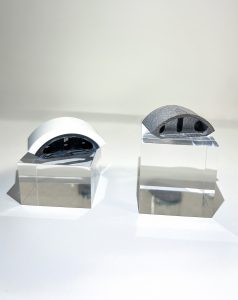
Additive manufacturing provides complete design flexibility. Image: TANIOBIS
Digital modelling provides for numerous structures to be produced, including open-porous regions with an adjustable porosity of up to 70 percent. The underlying lattice structures can be precisely defined in the digital model and then exactly formed in the process. These kinds of porous structures are readily accessible for bones and allow an efficient level of integration of bone tissue into the implant. It is also possible to ideally adapt the mechanical properties and particularly the elasticity of the implant to the properties of the surrounding bone.
Additive manufacturing provides complete design flexibility in terms of the structure of the component and is particularly suitable for patient-specific implants. The patient’s anatomical features can be determined quickly and reliably on the basis of CT or MRT data.
AMtrinsic® powders optimized for additive manufacturing
The AMtrinsic® powders produced by TANIOBIS GmbH play a key role in medical 3D printing. They consist of gas-atomized, spherical tantalum and niobium alloys, which have been specially developed for use in additive manufacturing. The powders have a spherical particle shape, homogeneous morphologies and excellent flowing properties, which enables consistent layer formation and reliable processing in the powder bed. On this basis, it is possible to produce implant structures that make use of the specific benefits of the candidate alloys; their high degree of biocompatibility and resistance to corrosion, for example. The materials are therefore suitable for implants that can be individually adapted to anatomical requirements and are designed to promote the patient’s wellbeing with their improved properties and excellent compatibility. AMtrinsic® powders can be processed in all the common additive manufacturing technologies, including laser beam melting, selective electron beam melting and laser deposition welding.
Additive manufacturing is the technology of the future
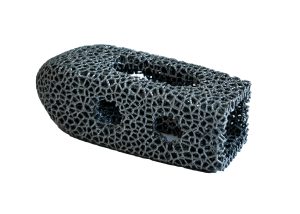
Tantalum and niobium alloys combine a high level of biological compatibility with mechanical properties close to natural bone. Image: TANIOBIS
Tantalum and niobium alloys combine a high level of biological compatibility with mechanical properties that are far closer to those of natural bone than traditional titanium materials.
When combined with additive manufacturing, which enables complex and patient-specific implant structures, they offer significant potential for the next generation of medical implants. They are therefore viewed as very promising materials for applications that require long-term stability, individual adaptability and improved integration into the surrounding tissue.
By TANIOBIS GmbH
www.taniobis.com
Source : Advanced Ti–Nb–Ta Alloys for Bone Implants with Improved Functionality , MDPI