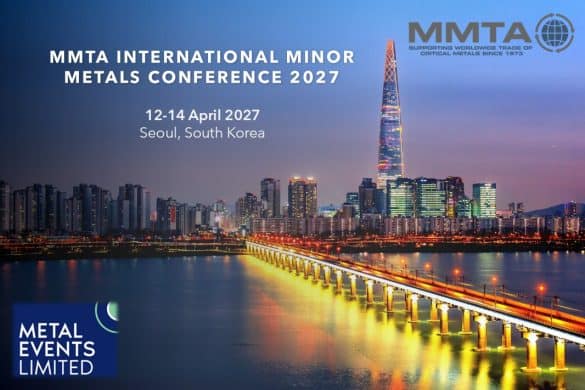
 The MMTA International Minor Metals Conference returned to North America in 2026, taking place in the beautiful and
welcoming city of Vancouver, on Canada’s west coast.

The sell out conference brought together 350 delegates for a packed event focused on geopolitics and strategic metal supply chains.
The event kicked off on Monday 20th April with a golf tournament organised by ICD Group. This was followed by the networking margarita cocktails in the evening kindly sponsored by IMS Metals and Alloys.
After registration began on Tuesday 21st April, the conference was officially opened by welcoming drinks, sponsored by CCMA LLC.
Conference Sessions, Day 1
Fuelled by coffee generously sponsored by Exotech, we kicked off Wednesday 22 April with the MMTA annual general meeting, where Chris Brzozowski was elected the new chairman (see board election results), following Stephen Hall’s excellent and proactive tenure. It was Chris’s turn to welcome delegates to the opening of the MMTA conference.
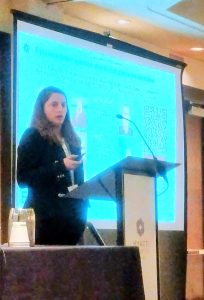
Carolina Frey, ATI
Carolina Frey, R&D Metallurgist, ATI Specialist Materials took us on a whistlestop tour through refractory alloys from historic to modern. She explained the challenges of substitution, such as of hafnium in response to its rising cost, used to strengthen high temperature alloys with niobium, or of tungsten for its high melting point.
Dr Thomas Feldmann of 5 N Plus addressed the key issue that geopolitics is playing in the evolving world on minor metals, most of which are national or supranational critical raw material lists. Here, Europe is more insulated than the US from tensions with China, and its efforts to secure domestic supply are not as urgent, whereas the onshoring efforts in the US are faster but less predictable. Recycling is starting to play its part, both from reprocessing copper tailings and recovery from downstream products.
Jan Giese of Tradium focused on electronic metals and highlighted the almost complete drying up of Chinese supply of yttrium to the US and especially since a ban in early 2026 Japan, both having been major importers only two years ago. This is not the only market that is becoming increasingly domestic. Demand from solar cells is contributing to the potential tripling of Chinese demand for gallium which has switched from an export-led to a largely internal market. Meanwhile, China’s stockpiling of germanium remains an unknown factor in the market for this strategically important metal, not least for defence optics, with at least 20t of supply missing from the global market.
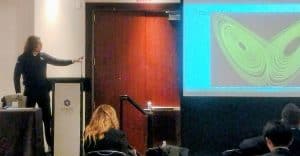
Theo Ruas, Indium Corp
We needed that second dose of coffee (or its infinite varieties from the Exotech barista stall) to keep up with the whirlwind presentation from Theo Ruas of Indium Corp. Here, theoretical physics met metal market dynamics, complete with the chaos theory and the butterfly effect. You know you are at the MMTA conference when this happens. Bringing the theories down to metallic elements, a reminder to look at the fundamental drivers beyond the specific market, such as analysing the trends in zinc if you want to understand what is happening in its co-occurring minor metal, indium.
Mandy Yin of Zhuzhou Keneng New Material Co followed up with a candid look at the challenges of China’s gallium and indium industries, including the fall in by-product metal output from cuts to base metals production and that lower by-product recoveries, that span base metals industries including aluminium, copper and zinc. Restrictions of dual-use exports, aimed at limiting proliferation, have disrupted the export flow of both indium and germanium, and both industries are facing the challenge of material substitution.
Fastmarkets’ Grace Asenov drew on decades of Fastmarkets’ weekly records of antimony benchmark pricing to give the conference an arching overview of the minor metal’s market developments and to pinpoint where it is today.
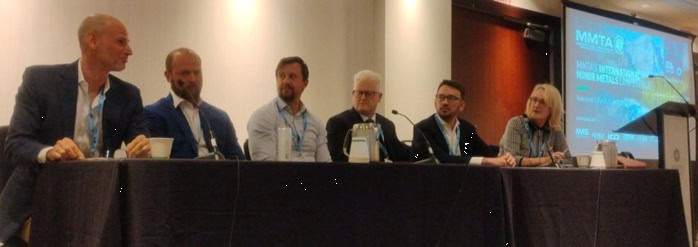
MMTA Conference Panel (left to right): David Abraham, Associate Professor, Boise University; Melvin Hill, vice president, GE Chaplin; Marcyn Zydowicz, Trade Commissioner, Energy and Mining, High Commission of Canada; Ian Margerison, Tantalum-Niobium International Study Center (T.I.C.); Michael Husakiewicz, senior trader and director, Lipmann Walton; and Rachel Carnac, founder and director Metal Events Limited.
After a luncheon, sponsored by Titan International, a panel chaired by Rachel Carnac of Metals Events debated how minor metals defined a new world order in trade, technology and defence. The panel debated in particular the differing tools that governments can choose to use to secure critical materials supply.
While the US has moved from strategic stockpiling into taking direct equity in strategic projects, to underpin its rare earth dependent industries or investing in solar capacity build-up, the Canadian, EU or UK’s approach is less focused on trying to control upstream and downstream aspects of supply on a national level. Their strategy is rather to help derisk offtake agreements for companies diversifying their supply chains.
 Increasingly in the EU, this is not a sovereign but a federal strategy, with EU countries looking to pool their resources, export development and credit agencies.
In the evening, pre-dinner drinks, hosted by Advanced Alloy Services led us into the Gala dinner generously sponsored by ATI, ICD Group and Donald McArthy Alloy Processors.
Conference Sessions, Day 1
 With barista coffee once again flowing through the day, courtesy of Exotech, the morning session was opened by Hanson Wu, sales manager at Ningbo Chuangrun New Materials Company (CRNMC) who guided delegates through the evolving range of high performance metal products in titanium, tantalum, niobium, and molybdenum, for medical, superalloy and other high-tech applications. CRNMC is the only manufacturer in China with capability to produce semiconductor grade titanium, using its in-house electrolytic technology, targeting 5,000t/yr of electrolytic titanium metal.
William Parry Jones, director, Wolfram Advisory, took delegates on a journey through the fundamentals behind the volatile tungsten market. During the conference, much of the discussion focused on tungsten, which has started coming off its price peak.
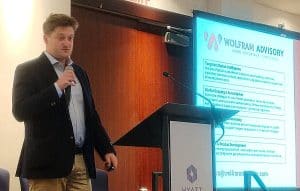
William Parry Jones, Wolfram Advisory
Although tungsten mine production is ramping up outside China, mostly via expansions, it has not closed the gap left by trade barriers and China increasingly focusing on its domestic markets, Parry Jones said. Here, securing secondary supply becomes a strategic issue. While China is looking at lifting the ban on imports of scrap into the country, the US and the EU are considering a ban on tungsten scrap exports but boosting domestic recycling and refining capabilities. Meanwhile substitution is difficult, particularly in machining, that becomes a bottleneck for multiple downstream industrial chains, including automotive, aerospace and defence.
These three markets is where the conference session focused in the afternoon after the coffee break.
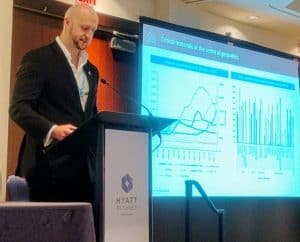
Scott Yarham, Project Blue
Scott Yarham presented Project Blue’s analysis of strategic metal markets which closely tracks the flow of raw materials to end product supply chains. Defence procurement is a rapidly growing metal market. In 2025 all NATO countries exceeded 2% of GDP spending on defence. Project Blue expects defence spending here to rise from an estimated $840bn to $1.9tr by 2035, assuming NATO defence spending meets its target of 3.5% of GDP, equating to 9% CAGR.
However, both the efforts to ramp up production in the west and attempts at substitution are struggling to catch up for metals such as yttrium and germanium, overwhelmingly reliant on China, with markets blindsided by China’s export controls for metals for dual use purposes. Intended as a non-proliferation measure, the strategy does indeed cut into defence, with germanium used in sensors and yttrium in jet engine coatings, for example. Downstream, while AI is growing, there is a shortage of chips to sustain data centres, Chinese-made chips can’t meet this demand, but there is expansion in Taiwan, and the US is starting to build up domestic capabilities.
There was a lot of ground to cover on the metals automotive markets, and Zach Schumacher raced us through them, with a vast array of Argus data and prices set out around the track, taking in metal consumption in electric vehicles and the impact of disruptions to upstream metal production.
The conference concluded with the luncheon sponsored by Titan International, but discussions very much continued around the tables and in the spaces outside. The MMTA thanks all speakers, delegates and sponsors, and our conference partner Metal Events for this year’s successful event.
MMTA International Minor Metals Conference 2026 Sponsors
Golf and Gala Dinner Sponsor

Gala Dinner Sponsors


Welcome Reception Sponsor

Luncheon Sponsor

Coffee Sponsor

Pre-dinner Drinks Sponsor

Margarita cocktails Sponsor

Conference Organisers