How scandium and yttrium shortages are tightening aerospace and semiconductor supply chains
© Global Trade
Tracker, Project Blue
Shortages of yttrium and scandium are exposing a critical weakness in advanced manufacturing supply chains. Despite their tiny volumes, disruptions to these specialised materials risk amplifying existing bottlenecks across the aerospace and electronics sectors.
Reuters’ recent coverage of the yttrium and scandium shortages affecting US aerospace and semiconductor manufacturers emphasised increasing vulnerability in global supply chains as industries become increasingly dependent on critical minor materials produced in extremely limited volumes.
Whilst attention typically focuses on more well-known metal markets such as aluminium, titanium, or nickel, disruptions in minor metals can propagate quickly through advanced manufacturing. China’s export licensing regime for rare earth elements continues to constrain shipments despite the easing of trade tensions, creating supply uncertainty across downstream industries, including electronics and aerospace. This vulnerability is particularly visible in aerospace manufacturing, where both yttrium and scandium play specialised but essential roles.
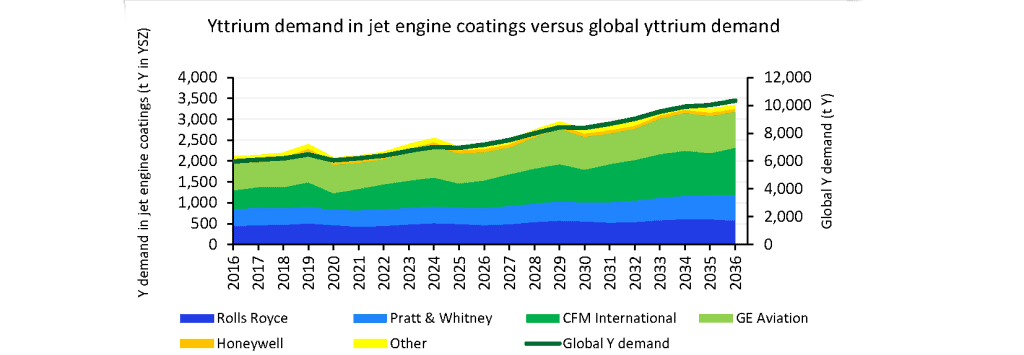
Both commercial and military aerospace sectors are particularly exposed to disruptions in yttrium supply. Yttrium is a key component of yttria-stabilised zirconia (YSZ), the thermal barrier coating used on turbine blades, vanes, and combustion chamber liners in modern jet engines. These coatings allow engines to operate at higher temperatures, improving fuel efficiency and durability. Disruptions in yttrium supply could therefore affect engine production and maintenance cycles.

Project Blue’s unique aerospace model tracks aircraft and engine deliveries, translating them into demand forecasts for critical materials, including alloys, coatings, and electronic components. It also monitors yttrium usage across jet engine programmes and manufacturers, emphasising the extent of reliance on YSZ coatings. Project Blue estimates that global yttrium consumption reached 6.9kt in 2025, of which approximately 2.3kt was used in jet engine coatings.
© Project Blue, 2026
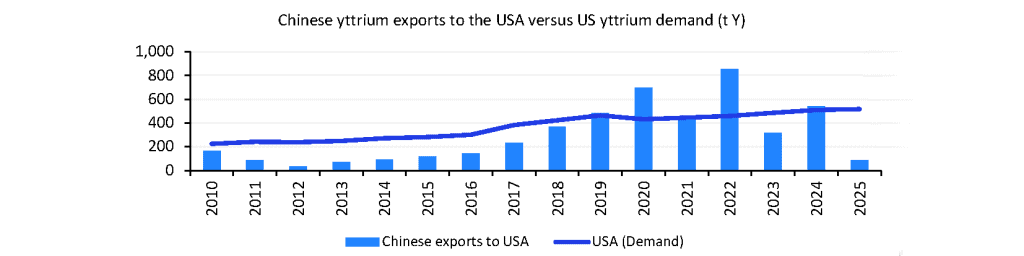
It has been reported that North American firms have had to temporarily pause or stop coating production due to shortages of yttrium. In 2025, demand for yttrium in the USA was estimated at 516.2t, whereas imports from China totalled 87.0t, indicating a significant supply gap. This shortfall was likely partly met through the release of existing inventories held by US consumers and traders, as well as through re-exports and entrepôt trade of Chinese-origin materials via third countries, most notably Japan and Austria.
This highlights the country’s reliance on global supply chains, as the USA does not produce yttrium domestically. Such dependence illustrates the structural vulnerability of the supply chain. Although Beijing has permitted many rare earth exports to resume following the initial restrictions imposed in April 2025, shipments of these materials still rarely reach the USA, even after the easing of diplomatic relations with Washington in October last year.

© Project Blue, 2026
Similarly, the scandium market illustrates the extreme fragility of supply in emerging aerospace and semiconductor materials. Project Blue estimates that global refined scandium production reached 38.1t in 2025, against consumption of 33.1t, leaving minimal buffer capacity in the market. Electronics applications alone accounted for approximately 2.0t of global demand, reflecting scandium’s growing role in advanced semiconductor processing and related technologies.
Within this segment, a portion of scandium consumption is associated with aerospace electronics, including radar systems, avionics sensors, and electronic warfare equipment. Project Blue estimates that scandium demand in aerospace electronics reached 0.23t in 2025, highlighting the extremely small, yet strategically important, volumes used in these systems.
The most relevant material system in this area is aluminium–scandium nitride (AlScN), a piezoelectric thin-film material increasingly used in radiofrequency (RF) filters, resonators and micro-electromechanical systems. RF technologies operate in the electro-magnetic spectrum used for wireless communications and sensing. These devices are produced using sputtering targets to deposit precise thin films onto semiconductor wafers.
By incorporating scandium into aluminium nitride (AlN), AlScN significantly improves electromechanical coupling, allowing RF components to operate at higher frequencies and with greater efficiency. As a result, the material is gaining importance in high-frequency communications, sensing, and timing devices used in aerospace and defence platforms. In modern aircraft and defence systems, these components underpin radar arrays, satellite communications links, secure communications systems, and high-frequency sensing technologies, as well as infrastructure supporting advanced telecommunications networks such as 5G and emerging 6G systems.
In the USA, semiconductor manufacturers have recently reported delays in obtaining Chinese export licences for scandium, raising concerns that supply controls may increasingly target strategic downstream sectors. As previously mentioned, the USA has no domestic scandium production and remains reliant on imports, with only 10kg of scandium metal imported in 2025.
Despite being used in small volumes, scandium remains strategical-ly important across advanced manufacturing sectors. It is used in RF electronics and semiconductor technologies, as well as high-performance aluminium alloys for aerospace structures and solid oxide fuel cells. With global production limited to roughly 30–40t per year and minimal inventory buffers, even minor trade disruptions can tighten supply rapidly.
These pressures come as the aviation industry already faces engine supply constraints, with delivery delays limiting aircraft production across major airframe programmes. Shortages of specialised materials used in coatings and electronics could therefore amplify existing bottlenecks.
Rather than a temporary disruption, these developments reflect a broader shift in critical mineral markets, where export controls and strategic sourcing increasingly shape access to specialised materials. Although yttrium and scandium shortages have not yet disrupt-ed engine or semiconductor production, recent geopolitical tensions have highlighted the fragility of these supply chains. In this environment, resilience will depend not only on securing large material volumes but also on reliable access to the smallest, yet most technologically indispensable inputs.
By Project Blue

*This article was updated on 23 April 2026 with a new chart for scandium demand in electronics vs total global scandium demand.

MMTA members are entitled to a 10% discount on registration fees for the below Project Blue event.
Log in into your Member Benefits Page to access all MMTA member discount codes.
Register Here