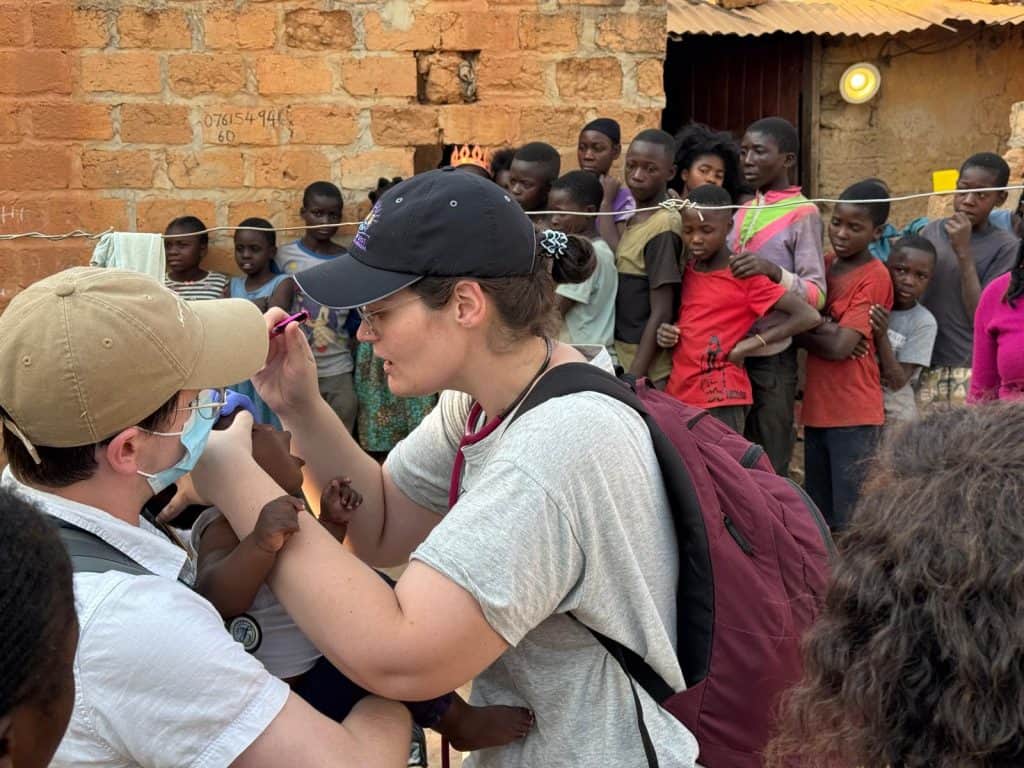
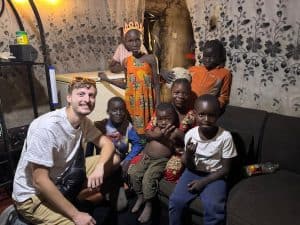
FOM medical electives Maddy Gallagher and Isaac Fazey-Koven, , with child patients in Mufulira. Photo © Richard Schindler, 2025
Doctors in search of diagnosis
In the late 19th and early 20th centuries physicians developed and relied on clinical skills of history-taking and physical examination, aided by simple diagnostic tools such as the stethoscope and simple devices for examining inside the eyes and ears. Gradually in developed countries, these skills have become less important as extensive blood tests, X-rays, ECG machines, ultrasound, echo CT and PET scanners have become the standard diagnostic tools.
Our elective students see Zambian clinicians managing seriously ill patients, relying solely on their highly honed clinical skills, as sadly they are often not able to access even the most basic diagnostic equipment.
Indeed, our first elective of 2025, Jenny Blackkwood from the University of Edinburgh, reported a shortage of X-ray films and developer, as well as laboratory failures meaning even the most basic blood tests could not be carried out. I mention this because it is a situation so different to the one our medics will experience when they graduate to become physicians in the UK.
Jenny, like her predecessors on the Friends of Mufulira (FOM) elective programme, circulated among different wards – Obstetrics, Gynaecology, Neonatal. She saw, as she recounted in her post-placement report, pre-eclampsia, gestational diabetes, and intra-uterine foetal death (IUFD).
And yet, she said, she saw and learnt a so much from the doctors and nurses who mentored her at Ronald Ross Hospital despite the limited resources which so deeply affect outcomes – especially child mortality. Many of these were local clinicians working without pay, which is common practice in the hope of a paid post coming up somewhere in the Zambian healthcare system in the future.
 As Richard Schindler, an elective from the University of Liverpool reported, medical care at the hospital is mostly led by junior doctors, frequently working 24 hour shifts. They had input from consultants, but, depending on specialism, some consultants spent minimal time at the hospital. Other departments, such as psychiatry or A&E are led solely by clinical officers, who undergo only three years of medical training, including six month of specialty training, as opposed to seven years of medical school for Zambian doctors.
Friends of Mufulira is a very small charity and yet we represent a large and wealthy industry that has gained great profit from working in resource-rich countries such as Zambia. And yet, it is not always the big-ticket items that are going to give most succour. Our electives report that some of the most basic and relatively cheap diagnostic tools would save lives – glucometers, glucose sticks, pulse oximeters and basic improved infection control with a greater provision of PPE, disposable gloves and sanitiser.
Our work this last two years, aside from the elective programme, has centred on the maternity suite — the old one having only a single toilet and shower to be shared by those in labour and after delivery.
The improvements we have funded have done much to improve this situation with equipment on its way to assist monitoring premature and low birth weight babies, and further plans to help the hospital improve the neonatal care unit using low tech sustainable incubators and ventilation designed for developing countries.
At the same time we have established links with Zambia’s only neonatal specialist, who is advising us on the purchase of appropriate equipment, and providing training and support.
Obstetrics, gynaecology and neonatal care are by far not the only areas of need. A side-benefit of the elective programme for the charity is that students out in the field help FOM identify where the needs are and how they are being met.
Isaac Fazey-Koven, a 2025 electives from the University of Liverpool gives a number of examples of “bush medicine”. This is a practice of problem-solving with affordable and available alternatives and adaptations due to significant lack of resources or equipment deficiencies that make “gold standard” medicine practice a distant dream. (Isaac notes that similar practices are emerging in the UK’s NHS, with limited resources and pressure to cut waiting lists.):
“From my observations, deficiencies were the worst in internal medicine. Departments like obstetrics and paediatrics are easy targets for both governmental and charitable investments — it’s easy to sell “saving the children”, but there is no glamour in IM. There are many, many factors contributing to this, from the insurmountable prevalence of chronic infections like HIV and TB, to the lack of different treatment options for diabetes or hypertension.
The conversation with Dr Singogo led me to reflect on some of the practices I had first admired. As creative as the use of cannulas to drain the pleural effusion was, it did take over an hour and a half, and required me to sit holding a kidney dish to catch the fluid of a possible XDR-TB (extensively-multi-drug resistant tuberculosis) patient with only gloves and mask as PPE. “
Our work at FOM will never be complete, but we do what we can. Our annual twinning continues to feed up-to-date information back so that our Trustees, two of whom are doctors, can guide the rest of us where best to direct our efforts. Please support our work. We have been working with Ronald Ross General Hospital in Mufulira for well over ten years, with four changes of President.
So, one thing we can say is – we are not fair-weather friend and hope and believe we are doing some good.
By Anthony Lipmann, Trustee, Friends of Mufulira
 Or select Friends of Mufulira as your charity to donate as you shop via https://www.easyfundraising.org.uk/