MMTA and Fastmarkets Round Table in New York, 2026
MMTA/Fastmarkets Critical Minerals Roundtable takeaways
Minor Metals Trade Association (MMTA) and Fastmarkets held a timely third annual Critical Minerals Roundtable in New York City on Thursday January 29, where experts discussed the growing challenges faced in securing strategic minerals on the heels of the US administration’s ramped-up focus on critical minerals, with talk of Section 232 tariffs, price floors, and stockpiling.

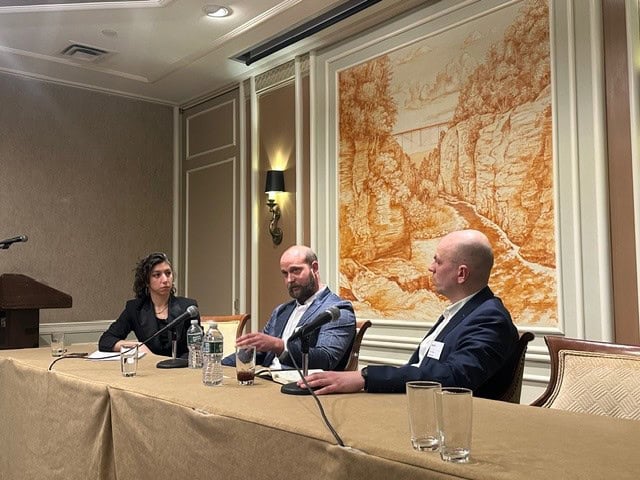
Freya Kerwin, MMTA MD and Rae Boyadjis, Fastmarkets
Price Reporter, non-ferrous, America at the joint round table.
During the first of the day’s two panels, market participants discussed industry efforts to strengthen supply chains for high-impact minor metals, with a focus on indium and tungsten.
The discussion touched on supply concentration risks, policy hurdles and strategies to overcome price volatility as Western supply chains adapt to shifting trade and regulatory pressures.
Indium under pressure
Between China’s restriction on exports and the US Defense Logistics Agency’s (DLA) January 15purchase requisition or-der to acquire up to 403 tonnes of indium metal over three years for the National Defense Stockpile, an already-thin market is feeling the stress.
Additionally, according to Brian O’Neill, indium manager at manufacturer AIM Specialty Materials, the indium market is far smaller than most people appreciate.
“The problem for indium is that it’s a 1,000 tonne per year market, and about 70% of that is produced in China — so that means 30% is left to the rest of the world… but the US has isolated itself through the tariffs,” O’Neill said during the roundtable discussion. So essentially, “for the West, it’s a 300 tonne per year market,” O’Neill explained.
Despite the small size, the indium market was still more or less supplied until prices in China shot up in the fourth quarter of 2025. These increases kept material in China, rather than being exported to nearing Asian countries and eventually trickling to the US, O’Neill said. This has caused the US market to become even tighter, with spot material almost impos-sible to come by.
Then flying over the top, we get hit with the DLA request for 400 tonnes. In a 300 tonne market, that’s out of balance, even if its spread over years,” O’Neill said.
“They didn’t intend to cause a disruption… but didn’t appreciate how small the indium market is. It was already tight, and now the spot market is pretty much dried up,” O’Neill said.
Fastmarkets’ twice weekly indium 99.99%, in-whys Rotterdam price was last assessed at $530-630 per kg on Friday January 30, up from $376-405 per kg on December 31, 2025, and $345-390 per kg on January31, 2025.Fastmarkets’ weekly indium 99.99%, exw China price was last assessed at ¥4,500-4,700 ($647-676) per kg on January 30, as compared to ¥2,600-2,630 per kg on December 26, 2025, and ¥2,500-2,550 per kg on January 24, 2025.
Advancing tungsten with administrative support
Brodie Sutherland, chief executive officer of developer Patriot Critical Minerals, echoed some of these sentiments in the tungsten market, highlighting the importance of production coming online in other parts of the world as export controls continue to inflate prices outside of China.
“It’s a very similar story to indium: China controls 83% of tungsten production. What’s happened is there’s been a decrease in production in China, down 6% year over year for the last few years. The price of tungsten in China is higher than it is here, and the reality is that we need that movement to re-ignite some of the existing projects around the world,” Sutherland said during the panel.
Sutherland said the next-largest producing country is Vietnam, with other projects coming online in South Korea — but these projects will take time. According to the company’s website, Patriot is also advancing the largest Securities and Exchange Commission (SEC)-compliant tungsten resource in the US to support national security and industrial independence.
Patriot controls 100% of the MEGA Deposit at Elko County in Nevada and is positioning itself to be able to support US secu-rity priorities, as well as contribute to the reduction in reliance on supply from China.
“We see big support at this level, and this is the time for us to keep asking for assets like this,” Sutherland said during the January 29 panel. Sutherland said the project will take about three to five years, and that is incredibly fast for a mine.
There’s a massive knowledge gap from the public, from the administration, about what it takes to actually develop a pro-ject, whether it’s a processing facility or a mine. It will take a few years, but we are looking to accelerate things,”
Sutherland also cited initiatives like Fast-41 as key ways to accelerate projects and build strategic infrastructure.
According to the US Environmental Protection Agency, Fast-41 refers to Title 41 of the FAST Act, which is aimed at improv-ing the timeliness, predictability, and transparency of federal environmental review and authorization processes for cov-ered infrastructure projects. Sutherland explained that Fast-41 has now been tailored toward critical minerals projects, with 12 critical minerals companies applying in 2025.
If we are going to catch up, we need every advantage we can get. You can’t cut corners when you build a mine, but there are certain things we can do to help increase the rate we can get them online,” Sutherland said.
Additionally, tools like price floors are crucial to this moment in minor metals, as are other forms of government support, according to Sutherland. “The key thing and the message we’re getting from Washington is very clear. It’s about longevity and self-reliance. In order to get there, you need to support all of these projects at the base level, and that starts with mechanisms like price floors,” Sutherland said.
Fastmarkets’ weekly tungsten APT 88.5% WO3 min cif Rotterdam and Baltimore duty-free price was assessed at $1,100 -1,398 per metric tonne unit of WO3 on January 30, up from $825-900 per mtu WO3on December 26, 2025, and $330-355 per mtu WO3 on January 31, 2025.
Filling in the gaps: the role of recycling
In markets that are already feeling the pressure, recycling can play a part in the supply story.
“I try to talk about this in two different ways: one is how recy-cling can round out peaks and valleys of our supply and de-mand,” David Gussack, president of recycler Exotech Inc. said during the panel. “As a 35-year-old company in the scrap world, we’re hoarders. When prices are low, supply is high and demand is low; we buy, and we hold, and we wait.
When prices go up, and demand is high and supply is low, we let things go. That’s what we do — we can round out those valleys and peaks.”
Because recycling companies consistently have material on the ground, they fit very well into the spot market, Gussack explained. “Traders might think about how many vessels or how many containers, but we might be thinking in terms of one tonne, three tonnes, 50 [kg], and ‘can I have it tomorrow?’ And that’s part of how we support,” he said.
Another benefit of the recycling industry is that traditional producers may not be able to achieve the needs of certain customers.
“Like applications for tantalum, like 4-9 or 5-9 purity application: a typical producer in China isn’t making a4-9 product, but we might be able to take a recycled product that went through so much refining it may already be that purity appli-cation. It’s a small volume, but we can support those unique applications that can be almost impossible to supply any-where else,” Gussack said.
Like Sutherland, Gussack is also encouraged by how the ad-ministration has supported domestic manufacturing.
I believe we should be supporting all these long-term projects and domestic manufacturing projects because if we’re producing in the [US], scrap will also stay domestic: we’ll process it here and it will re-enter the market here,” Gussack said.
“In 2025, the USGS [US Geological Survey] was updating the list of critical minerals for the federal government and we looked at 84 commodities — each one is a story,” Elisa Alonso, assistant section chief of minerals intelligence researching, acting deputy director at the National Minerals Information Center at the USGS and deputy program manager at the De-fense Advanced Research Projects Agency’s (DARPA) Open Price Exploration for national security said.
By Rae Boyadjis
Price Reporter, non-ferrous, America