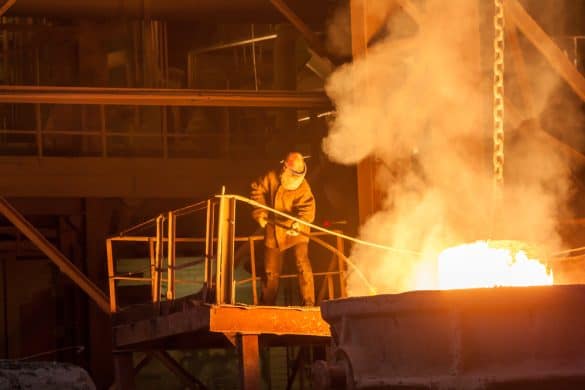
parent isotope of technetium Tc-99m, radionuclide used in nuclear medicine. Photo by Parilov, Shutterstock
On Radioisotopes
Dear MMTA Members,
My goodness I feel old! I trekked over to the UK in October to “celebrate” the 50th anniversary of my matriculation at university. Not surprisingly, having been somewhat of a reprobate during my tertiary “education”, whilst the majority of my peers sat at the top table, I was consigned as far from it as possible. Not really very surprising as they are “Sir …”, “Professor …” and “Dr … “. As far as I know, I am none of these. And quite surprisingly, it appears only some seven of my year are now dead!
Having looked back at my last missive on radioactive waste, I thought it might be worth, in this letter, taking a quick look at something more in this vein: radioisotopes.
This is not going to be a long read: more a speedy primer on what I believe to be an important subject. (And, if people want to learn more, I should be happy to write something a wee bit longer.)
What is an isotope?
I think the simplest way to envisage an atom is to imagine a nucleus, consisting of both protons and neutrons, surrounded by a cloud of electrons buzzing around this nucleus. The number of protons in the nuclei of any element’s atoms determines the chemical character of that element.
Different isotopes of an element all contain the same number of protons, but different numbers of neutrons and, hence, have different atomic masses. Whilst some isotopes are stable, others are unstable. The naturally occurring elements (around 90) are reckoned to occur as 339 different isotopes. Of these, approximately 250 are stable and 35 are unstable (radioactive)1. Back in 2015, the US Nuclear Science Advisory Committee (NSAC)2, put the number of natural and artificial radioactive isotopes as exceeding 3,200 and stated that this number “ … keeps growing every year.” So, I’m not sure how many we now have.
The nuclei of unstable isotopes usually stabilize through radioactive decay (hence such isotopes being known as
radioisotopes), i.e. the emission of alpha (α) particles —
two protons and two neutrons and/or beta (β) particles
— electrons or positrons, often (but not always) accompanied by the emission of gamma (γ) rays or electromagnetic
radiation. Unstable isotopes rarely occur in nature and are, nearly always, produced artificially. Either from the likes of linear accelerators and cyclotrons; or from nuclear and research reactors. (99mTc is produced as the radioisotope 99Mo (artificially produced) decays, and itself decays, through gamma ray emission (and a rearrangement of its nucleus) to become 99Tc.) The latest figure I have is 200 for the different radioisotopes currently regularly used today in a wide variety of applications.3
How are radioisotopes used?
Radioisotopes, either naturally occurring or artificially produced, are useful because, as mentioned above, they emit radiation, whether α, β, or γ. In the same way that there are different types of knives for different tasks in the kitchen, so, too, are there different radioisotopes for different jobs, whether in food and agriculture, industry, or medicine.
Fun Fact: used worldwide, smoke detectors (which use a minute quantity of 241Am—americium-241—a product from the decay of plutionum-241) represent the largest number of devices based on radioisotopes. And, to give you some idea of the size of the market, by 2029 some 135 million units are expected to be shipped globally.4 (A 2024 survey here in the US found that 99% of households have at least one smoke alarm.)5
In each of the different use-cases mentioned above, here are some examples:
|
Radioisotope |
Half-life |
Decay |
Some Uses |
|
Americium-241 |
432 Yrs |
α |
Smoke alarms and neutron gauging. |
|
Caesium-137 |
30.2 Yrs |
β |
Tracing and thickness gauging. |
|
Carbon-14* |
5,730 Yrs |
β |
Dating. Tracer in photosynthesis studies. |
|
Chlorine-36* |
301,000 Yrs |
β |
Measuring age of water – up to 2,000,000 years. |
|
Cobalt-60 |
5.3 Yrs |
β & γ |
Gamma radiography, gauging and sterilization. |
|
Gold-198 |
2.69 Days |
β |
Tracing factory waste pollution in oceans. |
|
Hydrogen-3* (tritium) |
12.32 Yrs |
β |
Measuring age of ‘young’ (up to 30 years) groundwater. In red building EXIT signs. |
|
Iridium-192 |
73.83 Days |
β |
Gamma radiography. |
|
Krypton-85 |
10.76 Yrs |
β & γ |
Industrial gauging and locating leaks. |
|
Lead-210* |
22.3 Yrs |
β |
Dating layers of sand and soil up to 80 years old. |
|
Magnesium-27 |
9.5 Mins |
β & γ |
Locating leaks. |
|
Manganese-54 |
312.2 Days |
γ |
Predicting the behavior of heavy metals in effluents from mining waste water. |
|
Nickel-63 |
100.1 Yrs |
β |
Light sensors in cameras and thickness gauging. |
|
Selenium-75 |
119.78 Days |
γ |
Gamma radiography and non-destructive testing. |
|
Sodium-24 |
15 Hrs |
β & γ |
Locating leaks. |
|
Strontium-90 |
28.8 Yrs |
β – |
Thickness gauging. |
|
Ytterbium-169 |
32 Days |
γ |
Gamma radiography. |
|
Zinc-65 |
244.26 Days |
γ |
Predicting the behavior of heavy metals in effluents from mining wastewater. |
Food And Agriculture
The radiation emitted by radioisotopes is used in a variety of different ways.
- Insect Eradication;
- Food Preservation;
- Fertilizer Labeling;
- Genetic Alteration; and
- Sterilization.
Industry
There is a wide variety of uses made of radioisotopes in industry. Some of the more important are in:
- Nuclear Gauging;
- Gamma Radiography; and
- Tracing.
Some of the radioisotopes commonly used in industry are:
|
Radioisotope |
Half-life |
Decay |
Some Uses |
|
Americium-241 |
432 Yrs |
α |
Smoke alarms and neutron gauging. |
|
Caesium-137 |
30.2 Yrs |
β |
Tracing and thickness gauging. |
|
Carbon-14* |
5,730 Yrs |
β |
Dating. Tracer in photosynthesis studies. |
|
Chlorine-36* |
301,000 Yrs |
β |
Measuring age of water – up to 2,000,000 years. |
|
Cobalt-60 |
5.3 Yrs |
β & γ |
Gamma radiography, gauging and sterilization. |
|
Gold-198 |
2.69 Days |
β |
Tracing factory waste pollution in oceans. |
|
Hydrogen-3* (tritium) |
12.32 Yrs |
β |
Measuring age of ‘young’ (up to 30 years) groundwater. In red building EXIT signs. |
|
Iridium-192 |
73.83 Days |
β |
Gamma radiography. |
|
Krypton-85 |
10.76 Yrs |
β & γ |
Industrial gauging and locating leaks. |
|
Lead-210* |
22.3 Yrs |
β |
Dating layers of sand and soil up to 80 years old. |
|
Magnesium-27 |
9.5 Mins |
β & γ |
Locating leaks. |
|
Manganese-54 |
312.2 Days |
γ |
Predicting the behavior of heavy metals in effluents from mining waste water. |
|
Nickel-63 |
100.1 Yrs |
β |
Light sensors in cameras and thickness gauging. |
|
Selenium-75 |
119.78 Days |
γ |
Gamma radiography and non-destructive testing. |
|
Sodium-24 |
15 Hrs |
β & γ |
Locating leaks. |
|
Strontium-90 |
28.8 Yrs |
β – |
Thickness gauging. |
|
Ytterbium-169 |
32 Days |
γ |
Gamma radiography. |
|
Zinc-65 |
244.26 Days |
γ |
Predicting the behavior of heavy metals in effluents from mining wastewater. |
Medicine
Three of the most important uses of radioisotopes in
medicine are:
- Sterilization;
- Medical Diagnostics; and
- Medical Treatments.
Some of the radioisotopes commonly used in medicine are shown in the table below.
|
Radioisotope |
Half-life |
Decay |
Some Uses |
|
Bismuth-213 |
46 Mins |
α |
Cancer therapy. |
|
Cobalt-60 |
5.27 Yrs |
γ |
Sterilization. |
|
Erbium-169 |
9.4 Days |
β – |
Relief of pain from arthritis. |
|
Iodine-125 |
60 Days |
γ |
Treatment of brain and prostate cancer. |
|
Phosphorous-32 |
14 Days |
β |
Treatment of excess red blood cells. |
|
Technetium-99m |
6 Hrs |
γ |
Used in many different imaging applications. |
|
Thallium-201 |
73 Hrs |
γ |
Diagnosis of coronary artery disease. |
|
Xenon-133 |
5 Days |
β – |
For pulmonary ventilation studies. |
Isotope Production
While there are a number of naturally occurring radioisotope, most of the 200 regularly used are produced artificially,
The three most important ways in which radioisotopes are currently produced are: a) in nuclear reactors; b) in research reactors; and, c) in cyclotrons and linear accelerators.
Nuclear Reactors
Although not the most common source of radioisotopes, a number of power reactors do produce radioisotopes. Put at its simplest, isotopes are made in a nuclear reactor through neutron gain: some of the million errant neutrons winging around inside the core of the reactor are absorbed by the nuclei of particular materials placed in the reactor’s core to do just that. For example, if one of cobalt’s stable isotopes, cobalt-59, is stuck in the core of a nuclear reactor and exposed to a high flux of neutrons, it can absorb some of these neutrons (adding one to each of its nuclei) and become the radioisotope cobalt-60.
Research Reactors
Radioisotopes are, currently, most commonly produced in research reactors through fission, or the splitting of the
nuclei in atoms.
Rather than neutrons being absorbed by the nuclei of other atoms, they are hurled at those other atoms to break up their nuclei and create byproducts in the form of radioisotopes. The speed of these neutrons and the temperature will determine exactly which radioisotopes are produced.
Cyclotrons And Linear Accelerators
Lastly, radioisotopes can be, and are, produced in either cyclotrons or linear accelerators. In both these, a beam of protons is accelerated, using magnets, before being smashed into a target to produce the required radioisotope.
One major difference between using a cyclotron and a nuclear reactor is that a cyclotron needs neither fissionable material nor uranium to produce radioisotopes. On the other hand, it can only accelerate charged particles and only protons can be added in this way to atomic nuclei.
(Indeed, while reactors produce neutron-rich nuclei, cyclotrons and linear accelerators, by adding protons, produce neutron-deficient nuclei. Because neutron-deficient and neutron-rich radioisotopes decay by different means they have different properties and are used for different purposes.)
Radioisotope demand and supply
Comparing and contrasting the isotopes used in industry and those used medically, the most obvious difference lies in their half-lives: those used in the industry are most usually considerably longer than those used in medicine. And herein lie some of the supply problems.
Focusing on those fission isotopes used in medicine and on a single such isotope, the greatest demand currently is for 99Mo (which decays to produce 99mTc). Over the years, however, there have been repeated supply shortages of 99mTc, each with serious effects in terms of diagnostic examinations delayed, rescheduled or cancelled, leading to the delayed treatment, for example, to cancer patients.
To me anyway, there appear to be two major supply bottlenecks. The first centres around the isotopes’ half-lives (99Mo—66 hours and 99mTc—six hours) and the resultant challenges. The 99Mo has to get to end users both efficiently and fast: delays and logistical snafus can be disastrous. And production capacity needs to be significantly in excess of demand to account not only for decay, but also both cooling and processing.
The second centres around the sources of 99Mo itself. Not only does most of the world’s supply come from just six reactors (widely spread across the globe), but also, five of these are over 50 years old. (In addition, limitations also arise from process complexities.) While as a stop-gap, when major reactors go ‘off line’, some take-up by the remaining reactors can ease supply difficulties, it does not answer the question as to where 99Mo will come from in the long term.
In addition, historically, reactors have been publicly funded research reactors. The irradiation services they provide have, de facto, been heavily subsidized—consider alone the commissioning and de-commissioning costs of a nuclear reactor. (Whether this will continue is another matter altogether.) So, quite obviously, since it is such a short-lived isotope, adequacy and reliability of supply are both of particular importance in the instance of 99Mo.
Some concluding observations
Until recently, a concern riding over all the above has been the use of proliferation-sensitive highly enriched uranium (HEU) —which can also be used to develop nuclear weapons — to produce radioisotopes. I understand that, as of March 2023, all reactors producing 99Mo use low enriched uranium (LEU) targets instead of proliferation-sensitive HEU. And while this may add some 20% to production costs, relative to hospitals’ costs, the cost of 99Mo itself is small.
This being the case, there appear to be few incentives now (either competitive or financial) for the industry to explore and develop or, indeed, invest it any alternative means of isotope production. All it needs to do is jack up prices.
However, here in the US, in light of shortages of 99mTc/99Mo last year, this could change if government policy did, with the provision of financial incentives (even if only temporary) to encourage improved capacity or the establishment of new suppliers of LEU-based 99Mo. There could, then, be some interesting opportunities, both research and investment, that may arise around both 99Mo and other medical isotopes.
From Cleveland Heights. I remain, as always.
Yours
Tom
©2025 Tom Butcher
1 National Isotope Research Center: Isotope Basics, https://www.isotopes.gov/isotope-basics
2 NSAC Isotopes Committee: Meeting Isotope Needs and Capturing Opportunities for the Future: The 2015 Long Range Plan for the DOE-NP Isotope Program, July 20, 2025, https://www.osti.gov/servlets/purl/1298983
3 Just one of the unfortunate casualties of President Trump’s antipathy towards the Environmental Protection Agency (EPA) has been the “death by a thousand cuts” of its website. So, when you get to the page “Radioisotopes Commonly Used in Devices by Industry”, you are warned: “EPA’s Web Archive: This content is not maintained and my no longer apply … ” It makes research somewhat more difficult.
4 arizton: Global Smoke Detector Market – Focused Insights 2024-2029, October
5 US Consumer Products Survey Commission: Survey on Use and Functionality of Smoke and Carbon Monoxide Alarms (SCOA) in Households, September 3, 2024, https://www.cpsc.gov/s3fs-public/CPSC_SCOA_Study_Full_Report_Final_6b_09_06_24.pdf